
September 20, 2026
Chasing 60 FPS and Squashing Legacy Bugs
v1.0.50 & .51 bring major under-the-hood improvements to Chill Dash: smoother performance, a fixed bike recovery bug, and cross-town deliveries with dynamic timers and rewards. A stronger foundation for what's ahead.
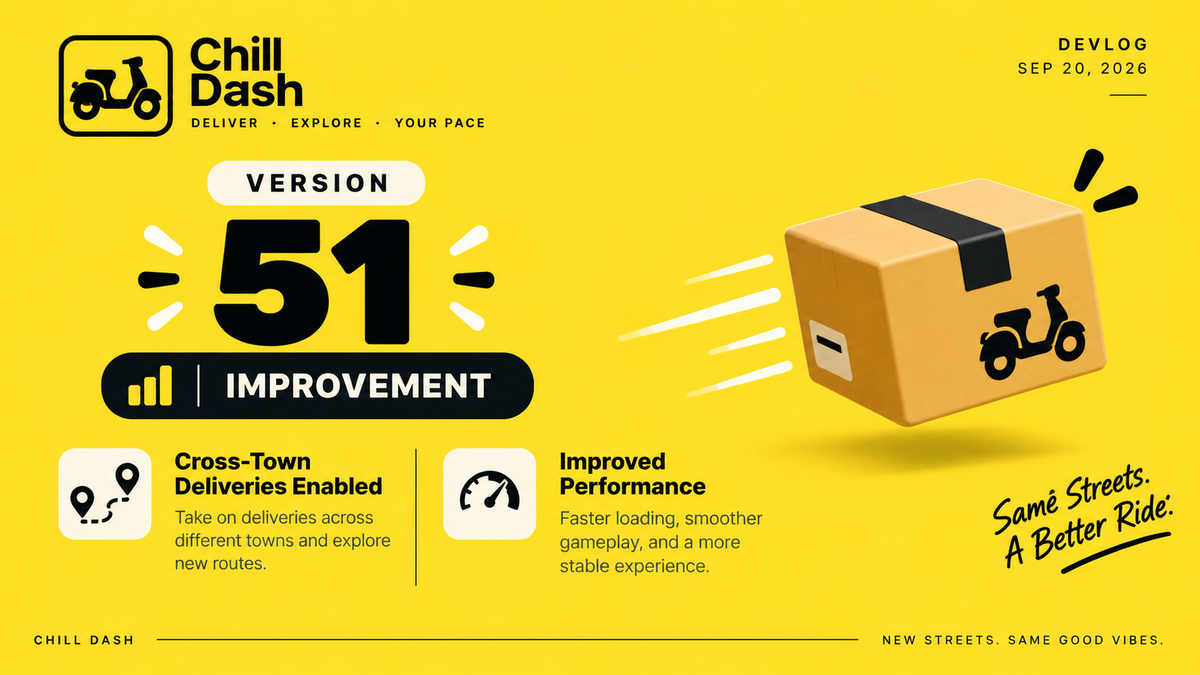
The latest builds (v1.0.50 and .51) are out, and they bring some of the biggest under-the-hood changes we've made to Chill Dash so far. We wanted to take a moment to pull back the curtain and talk about the engineering behind these updates—specifically how we tackled some tricky performance bottlenecks and a very weird gameplay ghost.
Here's a look at what we've been working on.
1. The Memory Leak and the Quest for 60 FPS
A while back, we noticed a trend: the game ran beautifully at launch, but over long sessions, it would slowly start to stutter. We eventually realized that a lot of our heavy lifting was flooding the React Native bridge and thrashing the garbage collector.
We fired up the profilers and found three major culprits. First, our SVG rendering pipeline was generating brand new strings for every moving object's transform coordinates on every single frame. This was causing memory to bloat rapidly until the system forced a heavy cleanup, creating a lag spike. We solved this by implementing cached, reusable math buffers so the memory footprint stays completely flat.
Second, our background auto-save was inadvertently triggering a full React component tree re-render even when nothing on-screen had actually changed. We decoupled the save state from the render cycle, allowing the engine to write to storage silently in the background.
Finally, we optimized the GPS system. Instead of drawing the entire navigation route across the whole map all at once, we implemented frustum culling to slice the polyline dynamically. Now, the game only ever renders the exact segment of the route that you can currently see on your screen.
2. The Mystery of the Self-Healing Bikes
Recently, a few sharp-eyed players noticed something strange happening with the survival mechanics. When a bike's fuel or condition dropped dangerously low, it would sometimes magically replenish on its own.
This definitely wasn't intended gameplay. After a lot of digging through the engine code, we traced the issue back to a legacy failsafe from our very early prototyping days. Back then, we had added a safety check to ensure brand-new accounts didn't accidentally spawn with a broken bike.
Turns out, this old piece of "training wheels" code was still alive and was accidentally getting triggered during routine background state syncs. We've officially ripped this legacy code out. Your bike will no longer miraculously fix itself on the highway—so keep a close eye on your gauges and plan your station stops carefully.
3. Opening Up the Map
We have a massive city map, but our dispatch system was keeping most deliveries somewhat localized. We wanted to introduce true cross-town, long-haul runs to make better use of the world.
The engineering challenge here was our timer system. Previously, delivery timers were fairly rigid, which made long-distance trips nearly impossible to complete. To fix this, we completely rewrote the dispatch logic. The system now dynamically calculates delivery deadlines based on the actual navigable route distance rather than relying on a static cap.
Along with the dynamic timers, we overhauled the reward generation. The dispatcher now natively scales payout and XP based on the complexity and distance of the route, making those massive cross-map journeys highly lucrative. We also updated the in-game phone UI to cleanly format these longer time limits and flag long-haul orders so you know what you're signing up for.
That's it for this week. It's been incredibly satisfying to clear out these technical hurdles and set a much stronger foundation for the game's future. Thanks for playing, and we'll see you on the road!